
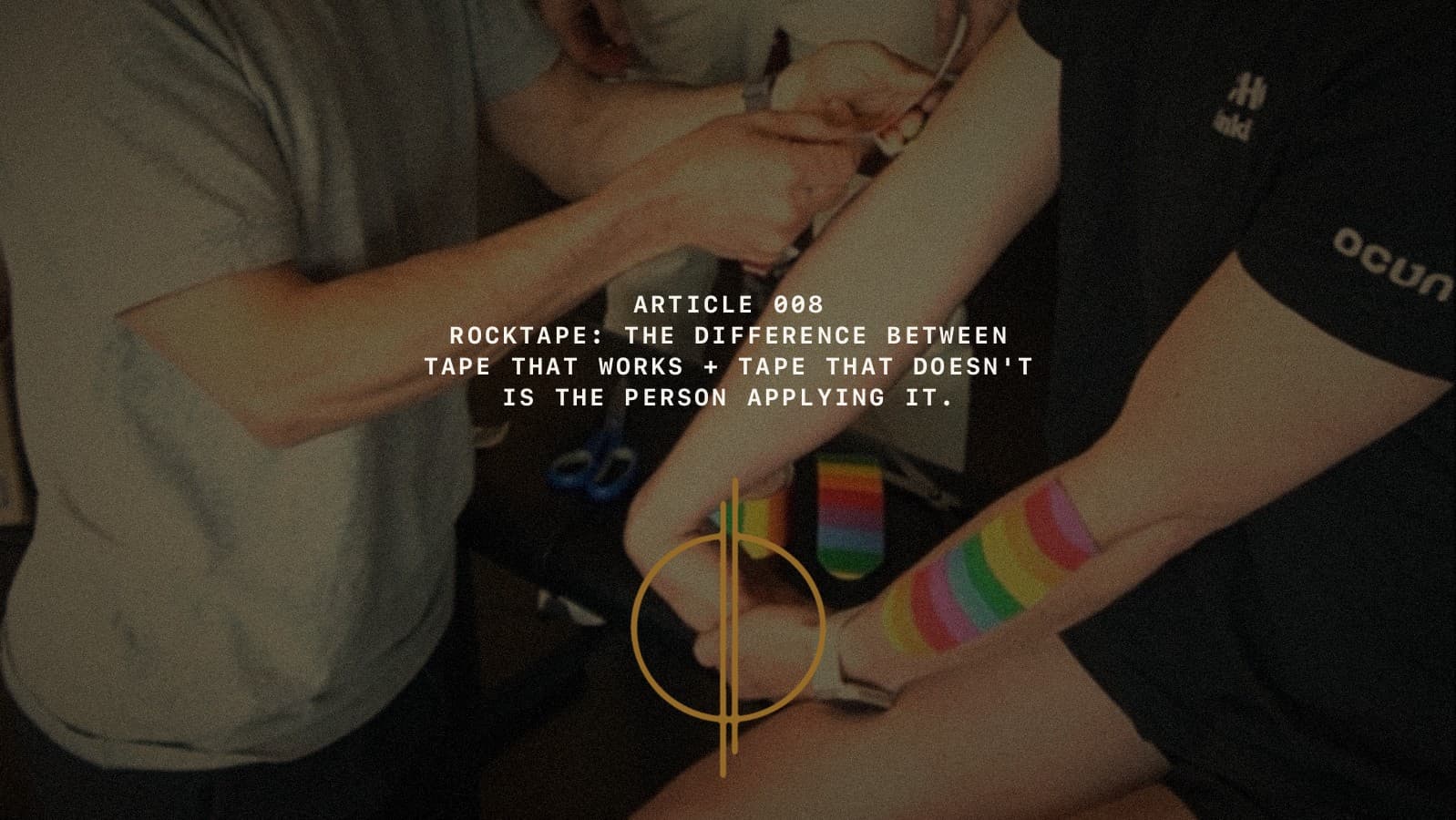
For practitioners and movement professionals — the difference between tape that works and tape that doesn't is the person applying it.
TLDR: RockTape is one of the most versatile clinical tools available to movement and health professionals — for pain, swelling, performance, and recovery. It works through the skin and nervous system, not around them. On June 14th, we're hosting a hands-on lab for practitioners who want to apply it with real confidence and clinical precision.
If you work with bodies — in a clinic, a gym, a treatment room, or on a field — you've seen RockTape. You've probably used it, or watched someone else use it, and noticed that results vary wildly depending on who applied it and how.
That variance comes down to clinical reasoning, application technique, and understanding what the tape is actually doing — and what it isn't.
What RockTape Actually Does
RockTape is a premium kinesiology tape — elastic, skin-safe, and applied with intention. Unlike rigid athletic tape that restricts movement, kinesiology tape works through its mechanical and neurosensory effects on the skin and tissue beneath it. When applied, it microscopically lifts the skin, which decompresses the layers of tissue below — potentially allowing lymphatic ducts and blood vessels to clear fluid more efficiently and reducing mechanical pressure on the nerve endings that signal discomfort. RockTape
In clinical terms, it operates across three channels:
Fluid effect — improving blood and lymphatic flow in the taped area. Mechanical effect — improving the slide and glide between tissue layers. Neurological effect — altering the perception of pain and improving body awareness. RockTape
That third one is where application precision matters most. Because discomfort and movement are both outputs from the brain, changing the input arriving from the taped area can change how the brain interprets that area — reducing pain perception and improving movement coordination without forcing the body to do anything it can't already do. RockTape
Tension, direction, and placement aren't aesthetic choices. They're the clinical variables that determine whether the tape does what you intend it to do.
Why Application Matters More Than the Tape Itself
This is the part most practitioners discover through trial and error. RockTape applied correctly extends and reinforces your session. Applied incorrectly — wrong tension, wrong direction, wrong anchor — it's just a colourful strip that falls off on day two.
The FMT (Functional Movement Taping) framework is built around a single shift in thinking: taping movement, not muscles — replacing the outdated model focused on directional taping, specific stretch percentages, and muscle activation or inhibition with an evidence-informed approach that treats tape as a tool for improving how the whole body moves. Mefitpro
For chiropractors, it reinforces nervous system integration after an adjustment. For physiotherapists and kinesiologists, it extends the session benefit — supporting load tolerance and movement quality while tissue heals. For massage therapists, it bridges the gap between treatment and the patient's next appointment. For personal trainers and athletic coaches, it creates what RockTape calls a proprioceptive hug — stimulating mechanical receptors in the skin and connective tissue that communicate directly with the brain, helping athletes coordinate movement more efficiently, reduce fatigue, and lower injury risk during training and competition. RockTape
Clinical studies have shown that kinesiology tape can significantly reduce pain and disability in patients with a variety of musculoskeletal conditions, with a 2021 randomized clinical trial of 36 studies demonstrating significant effects within just five days of application. RockTape
The tool is sound. The question is whether you're using it with the precision it requires.
The FMT+ Lab — Kinesiology Taping, Calgary
June 14th, 2026 · 3:00–7:00 PM Method Fitness, 230-580 24th Ave SW, Calgary — Mission
The FMT+ Lab is a 4-hour, fully supervised, hands-on workshop built for practitioners and movement professionals who want to apply kinesiology taping with clinical confidence.
How it works:
Step 1 — Complete the FMT Basic prerequisite on-demand. The foundational course is completed on your own schedule before the lab — that's where continuing education credits are earned and the theory lives. By the time you walk in, you have the knowledge. The lab is purely for application.
Step 2 — Four hours of supervised hands-on practice. Small group. Direct feedback. Applied taping strategies for the clinical presentations you actually see — tension, direction, and functional application from minute one. You leave confident, not just informed.
Who it's for: Chiropractors, physiotherapists, massage therapists, kinesiologists, personal trainers, athletic coaches, and allied health practitioners. Prerequisites apply — the FMT Basic course must be completed before attending.
Investment: $500 CAD — includes the FMT Basic prerequisite course.
This is the format that actually builds skill. Not another webinar. Hands on tape, hands on bodies, with practitioners who use this every day.
Register
Secure your spot: fmtplus.ca/p/fmt-lab-taping
Spots are limited by design. Small groups are the point.
Follow along: @philohealth.co
Philo Health — Calgary, Mission. philohealth.co
Sources:
- FMT+ Canada. FMT+ The Lab — Calgary June 14 2026. fmtplus.ca
Have a Question About Your Care?
Our team is happy to help. Reach out and we’ll get back to you.
Get in touch